Abstract
The lowlands of southern Mesoamerica, including the Petén region of Guatemala and the Yucatán Peninsula of Mexico, together with the highlands of Chiapas, formed the principal territory of the Maya civilization. The Maya developed sophisticated agricultural systems, including crop rotation, and established complex political, economic, and cultural networks. Language played a central role in the preservation of identity and in the transmission of pre-Hispanic literary traditions, while women served as the principal custodians of values, beliefs, oral traditions, tolerance, and frugality. Long before the arrival of the Spaniards, the Putun Maya controlled an extensive commercial network extending from Yucatán to the Gulf of Honduras, where cacao functioned both as a valuable commodity and as a medium of exchange. Important cacao-producing regions also included Soconusco, from which cacao was transported to Tenochtitlan. During the reigns of Izcoatl (1440) and Axayacatl (1469), the expansion of the Nahua states toward the Pacific coast of present-day Guatemala intensified political and commercial interactions throughout Mesoamerica. Between approximately AD 800 and 1400, several groups migrating southward from what is now Mexico encountered indigenous populations already established across Central America. These migrations transformed the demographic, political, and cultural landscape, as incoming groups often possessed greater military organization and displaced earlier inhabitants. Cultural practices, however, continued to circulate across the region. One example is the Flying Pole ritual, preserved today among the Papantla Voladores in Mexico and the K'iche' communities of Guatemala. A related ceremony was documented in 1529 at Tecoatega, Chinandega, Nicaragua, where young men descended from a ceremonial pole in rhythm with music performed by musicians on the ground. These traditions illustrate the continuity of ritual performance and oral transmission as essential elements of Mesoamerican identity and literary expression.
|
Published in
|
Social Sciences (Volume 15, Issue 6)
|
|
DOI
|
10.11648/j.ss.20261506.12
|
|
Page(s)
|
321-326 |
|
Creative Commons
|

This is an Open Access article, distributed under the terms of the Creative Commons Attribution 4.0 International License (http://creativecommons.org/licenses/by/4.0/), which permits unrestricted use, distribution and reproduction in any medium or format, provided the original work is properly cited.
|
|
Copyright
|
Copyright © The Author(s), 2026. Published by Science Publishing Group
|
Keywords
Mesoamerica, Maya Civilization, Nahuas, Cacao, Migration, Oral Tradition, Identity, Literature, Ritual Games
1. Methodology Brief
This study employs a qualitative, historical-anthropological approach, combining documentary research, archaeological evidence, and comparative analysis. Primary and secondary sources—including colonial chronicles, Indigenous texts, archaeological studies, and historical records—are examined to reconstruct patterns of migration, social organization, cultural interaction, and literary expression among the Indigenous peoples of Mesoamerica and Central America. The analysis also considers continuities between pre-Hispanic traditions and contemporary cultural practices, particularly language, ritual, community organization, and heritage.
The analysis argues that social groups examined through anthropological, archaeological and historical research, should be understood as living expressions of local communities and social systems through which Indigenous peoples organize their collective life. Far from being archaic remnants of the past, these organizations have functioned as dynamic spaces for the exercise of collective agency, the reproduction of social relationships, and the preservation of cultural identity in Central America countries.
2. Patterns of Migration and Social about Indigenous Peoples of Mesoamerica and Central America
Mesoamerica is a cultural concept invented by Paul Kirchoff in 1943 to designate a huge area where diverse cultures shared similar ethnic and cultural traits
| [24] | Paul Kirchoff. Mesoamerica. Wikipedia. |
[24]
. This cultural territory has been divided in five regions: the Central Highland, Western Mexico,- the Coast the Gulf of Mexico, Oaxaca and the Mayan Zone -Mexico, Belize, Guatemala, parts of El Salvador, Honduras, Nicaragua and Costa Rica.
Between 800 and 1400 A.D., the tribes that migrated southward from the present Mexican region faced the aborigines that had already settled in the Central American territory from coast to coast. Tribes from the north demonstrated greater military capacity and resources to evict the first settlers of the territory
| [9] | Folwer, William R. Jr. Los Pipiles. En Historia General de Guatemala, 1999. |
[9]
. Thus, Chorotegas and Niquiranos dominated the Pacific and the Primigenias tribes penetrated towards the center of the territory. A cultural difference was established that characterized from that time the aboriginal populations in their cultural and technological development
| [15] | Stone, Doris, 2004. Pre-Columbian Man Finds Central America. The Archaeological Bridge. Peabody University Press (Harvard University). |
[15]
. These migrations transformed the demographic, political, and cultural landscape, as incoming groups often possessed greater military organization and displaced earlier inhabitants. Cultural practices, however, continued to circulate across the region.
3. Pacific Coast Migrations
The
Nahua peoples of Central America left Tehuantepec and Soconusco between 700 and 850 A.D.
| [4] | Chinchilla, Oswaldo, 1998. Pipiles, Cakchiqueles en Cotzumalguapa. La evidencia etnohistórica y arqueológica. En Anales de Academia de Geografia e Historia de Guatemala. |
[4]
. The
Pipiles were expelled by the Olmec invaders from the Cerro de la Mesa (Oaxaca)
| [1] | Amador Berdugo, Fábio E. 1998. Revista Antropologia e História. No. 22, El Salvador, |
[1]
. They escaped from the oppression of the historical Olmecs and left Xoconoxco (Soconusco) passing through the south of Guatemala, settling in Mictlán (Asunción Mita), Yzcuintlan (Escuintla), Ezalcos (Izalco, El Salvador), Choluteca (Pacific Coast Honduras) and to other locations in Nicaragua, Costa Rica and Panama
| [3] | Campbell, Lyle, 1978. Quichean Prehistory. Linguistic Contributions in Studies in Mayan Linguistics. In Anthropology, No. 6. University of Missouri-Columbia, Columbia. |
[3]
. The Spaniard colonized gave the name of pipiles to the settlers of Escuintla (Guatemala) who spoke Nahuatl (Aztec) in a similar way to that of a child (pilli-niño in nahuatl). Doris Stone indicates that they spoke a primitive Nahuatl or Utazteca language.
The Chorotegas left for the south coming, from the Coast of Soconusco, to Chiapas towards the year 800 A.D. Their language was the Mangue. During their trip, groups settled in Nequepio (El Salvador), in the Gulf Coast of Fonseca (Honduras) where they were known as Cholutecas and others on the Pacific coast of Nicaragua and the Nicoya Peninsula. Shortly afterwards, these populations were followed by the Nahua-Pipil-Nicarao, also coming from Soconusco and Cholula, who evicted the Chorotegas from the isthmus of Rivas, forcing them to retreat to the eastern shore of the Gulf of Nicoya. The Niquirianos or Nicaraos and the Chorotegas, descendants of the Nahuatl android Toltec civilizations occupied the lands between the depression of the lakes of Nicaragua and the Pacific. In the rest of the region lived the Chontales (central shield) and the Caribes (Atlantic coast), the latter of much more backward culture
| [11] | González Vargas, Zamora, 2003, Rev. Patrimonio Cultural Centroamericano. Costa Rica, |
[11]
.
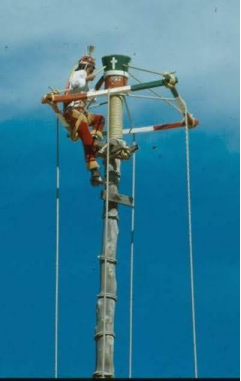
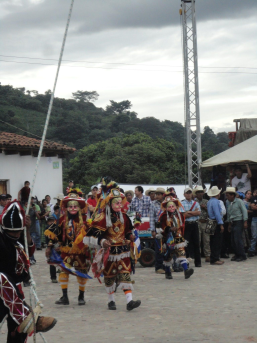
It is interesting to observe the cultural feature that was practiced in several places in Mesoamerica, and still practiced by the Papantla Voladores in the Valley of Mexico (
Figure 1) and the Kich'es in Guatemala (
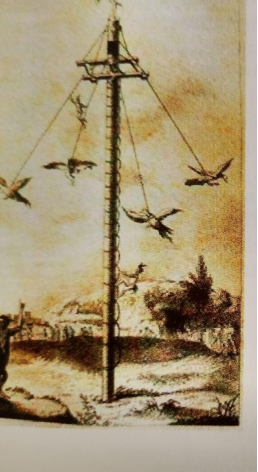
Figure 2). Fernandez de Oviedo visited Nicaragua in 1529 and described a ritual in Tecoatega, Chinandega in which the boys descending from the post followed the rhythm and the song of musicians on the ground (
Figure 3). The ceremony terminated with a period of silence followed by a great shout.
Figure 1. Papantla, Mexico. Photography Hugo Fidel Sacor, 1996.
Figure 2. Cubulco, Salama province, Guatemala. Photography, Hugo F. Sacor, 2012.
Figure 3. Flying in Nicaragua, as illustrated in Plate 11, Volume 3. In Fernandez de Oviedo. General and Natural History of the Indies, Islands and Tierra Firme del Mar ocean. Madrid, 1851-1855.
4. The Gulf of Honduras as Commercial Corridor for the Exchange of Cacao
Towards the time of the Spanish discovery, and probably much earlier, the Putun-Maya controlled a commercial canoe network. This network extended from the north near Chontalpa, around the Yucatan Peninsula (Mexico), and southward to the commercial centers of Nito and Naco, near the Gulf of Honduras
| [6] | Coe, Sophie D., Michael D.Coe, 1999. La Verdadera Historia del Chocolate. México, Fondo de Cultura Económica. |
[6]
. The commodity (and the currency) that fed this commercial machinery was cacao, as Fernando de Colon reported in 1538.
The corridor of the Pacific Coast was always a region of considerable migration of Pipils, Mangues and Subtiapa, traveling south from the Coast of Soconusco, in Chiapas, towards the year 800 A.D. One group settled in Nequepio (El Salvador) and another in the Gulf Coast of Fonseca (Honduras) where they are known as Cholutecas
| [23] | Grupos étnicos de Honduras. Wikipedia, la enciclopedia libre. |
[23].
5. Nicaragua: Pre-Hispanic Society
The indigenous peoples of Nicaragua were described during the sixteenth century by the Spanish chroniclers and historians Gonzalo Fernández de Oviedo y Valdés in
General and Natural History of the Indies and Antonio de Herrera y Tordesillas in
History of the Acts of the Castilians in the Islands and Mainland of the Ocean Sea | [8] | De Oviedo., Fernández, 1851-1855. Historia Generaly Natural de las Indias, Islas y Tierra Firme del Mar océano. Madrid. |
[8]
,
| [20] | Historia General de las Indias. Obra por el Capitán Gonzalo Fernández de Oviedo y Valdés. Publicada por La Real Academia de la Historia cervantesvirtual.com |
[20]
According to these accounts, one of the earliest peoples inhabiting Nicaragua were the Chontales (or Caribisis). They were said to have originated in Cholula, in central Mexico, and to have been displaced by the Olmecs, migrating first to the Soconusco region in southern Chiapas, where they became associated with the Chiapanec peoples. From there they continued southward, reaching the territory of present-day Nicaragua around A.D. 800
.
A second major migration involved the Chorotegas, traditionally considered to be of Mesoamerican origin, who arrived around A.D. 900 from southern Mexico and settled primarily along the Pacific coast. Around A.D. 1200, Nahua-speaking groups, related to the peoples of central Mexico, expanded into western Nicaragua and displaced many Chorotega communities from the Isthmus of Rivas. Some of the displaced populations are reported to have relocated toward the Caribbean region, where they were identified as the Macaroas.
The Miskito people emerged as a distinct political entity by the seventeenth century, with the Miskito Kingdom becoming established around 1625
| [26] | Pueblos indígenas de Nicaragua. Miskito. Wikipedia, la enciclopedia libre. |
[26]
. They maintained close alliances with the British during the colonial period and today number approximately 200,000 people who continue to speak the Miskito language. During the Nicaraguan Revolution, sectors of the Miskito population became involved in the conflict, with some groups aligning with the Contras
.
Oviedo y Valdés documented the linguistic diversity of nine indigenous groups in Nicaragua, noting that principal language closely resembled that of central Mexico, while Chorotega and Chontal were also widely spoken
| [25] | Pueblos indígenas de Nicaragua. Los chontales. Wikipedia, la enciclopedia libre. |
[25]
. Herrera provided detailed descriptions of Chontal society, including the architecture of their settlements—observing that the residences of chiefs differed from those of commoners—their clothing, which he considered similar to that of the peoples of central Mexico, as well as their customs relating to marriage, adultery, and other aspects of social life.
6. Pre-Hispanic Cultural Areas of Costa Rica
It is characterized by two major cultural traditions: the Mesoamerican Cultural Area and the Intermediate Cultural Area.
6.1. The Mesoamerican Cultural Area
Encompassed the northwestern region of present-day Costa Rica, particularly Santa Cruz (Guanacaste) and Greater Nicoya, where the advanced civilizations of Mesoamerica extended southward from Mexico.
At the time of the Spanish conquest, this region was inhabited primarily by the Chorotega people
. Gonzalo Fernández de Oviedo y Valdés, who visited the area in 1529, described their social organization and economy in his chronicles. According to his observations, marriage was generally monogamous and indissoluble; maize tortillas formed a dietary staple; cacao beans served as a medium of exchange; the ceremonial Volador ritual was practiced; the worship of deities associated with the Feathered Serpent, Tezcatlipoca, and Tlaloc was present; and finely crafted wooden swords decorated with carved designs were produced.
6.2. The Intermediate Cultural Area
It comprised most of present-day Costa Rica and was characterized by societies organized into chiefdoms governed by caciques (chiefs). These communities displayed strong cultural influences from both the Caribbean and northern South America. The cacique was responsible for redistributing surplus resources, resolving internal conflicts, administering justice, and performing religious and ceremonial duties. Historical evidence also indicates that women could hold the position of chieftain.
Archaeological evidence reveals a rich artistic tradition. Early ceramics dating from approximately 300 B.C. feature elaborate animal motifs, while monumental stone sculptures include ceremonial tables supported by tall, slender legs carved with human, reptilian, and avian figures. Among Costa Rica's most remarkable archaeological achievements are the stone spheres, dating between A.D. 500 and 1500, with diameters ranging from 0.7 to 2.57 meters. These monuments were inscribed on the UNESCO World Heritage List in 2014. In the South Pacific region, highly sophisticated gold ornaments were produced using the lost-wax casting and false filigree techniques, demonstrating the exceptional metallurgical skills of the region's pre-Hispanic artisans
| [2] | Cabrera Padilla, Roberto, 1989. Santa Cruz Guanacaste. Ediciones Guayacán, Costa Rica, Camargo, Marcela, 1977. Coclé. Arqueología: una breve crítica. Revista La Antigua, USMA, Panamá. |
| [5] | Coe, M. D. 2005. Costa Rican Archaeology and Mesopotamia. Southwestern Journal Anthropology. 18, 170-183, 1962. |
[2] [5]
.
7. Periods of Indigenous Cultural Occupation in Pre-Hispanic Panama
It has been identified primarily through ceramic studies. The major pre-Hispanic cultures of the Isthmus occupied the Province of Coclé, the Azuero Peninsula, Chiriquí, Veraguas to the west, and the Tonosí Valley.
The archaeological site of El Caño, first investigated by Hyatt Verrill in 1925 and later by Richard Cooke in 1973, contains basalt columns carved with zoomorphic and anthropomorphic figures, as well as burial mounds containing offerings of ceramics, lithic tools, and objects made of gold tumbaga.
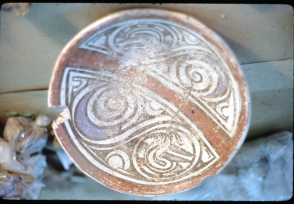
Ceramic analysis has made it possible to establish a sequence of cultural occupations, including ceramics dated to A.D. 300-500, smoked ware dated to A.D. 500-700, (
Figure 4) pedestal dishes dating to A.D. 700-1100, semi-globular vessels dating to A.D. 1100-1300, and plates dating to A.D. 1300-1500
| [2] | Cabrera Padilla, Roberto, 1989. Santa Cruz Guanacaste. Ediciones Guayacán, Costa Rica, Camargo, Marcela, 1977. Coclé. Arqueología: una breve crítica. Revista La Antigua, USMA, Panamá. |
| [7] | Cooke, Richard, 1973. Rescare arqueologico EL Caño. IV Simposio de Arqueologia. Arqueologia e História. Revista La Antigua, USMA, Panamá. |
[2, 7]
.
According to Spanish chroniclers, the pre-Hispanic societies of Panama practiced elaborate funerary rites in which individuals of high social status were buried with prestigious objects, including finely painted ceramics and gold ornaments. These societies were organized into cacicazgos, or chiefdoms. The term cacique referred to a leader who attained authority through military ability, political skill, and personal prestige. Rivalries among neighboring chiefdoms frequently resulted in warfare, raids, the capture of women, and the looting of wealthy burial sites
.
Figure 4. Ceramics with details of heron heads, phase Conte polychrome, Cocle culture, El Caño site. Foto Hugo Fidel Sacor, 1985.
When the Spaniards colonized the Isthmus of Panama in the early sixteenth century, they adopted the term areyto to describe ceremonial gatherings of the Indigenous peoples. During these events, the traditions, legends, and historical achievements of each community were celebrated through songs, dances, and poetic recitations. As in many non-literate societies, these oral traditions were memorized and transmitted from generation to generation, ensuring the preservation of collective memory and cultural identity
.
8. Pre-Hispanic Literary Expressions
The Maya suffered the destruction of one of the greatest cultural legacies of the ancient Americas: their hieroglyphic books. On July 12, 1562, the Franciscan friar Diego de Landa ordered the burning of numerous Maya codices at Maní, Yucatán.
| [10] | Gallenkamp, Charles. 1981. Los Mayas: el misterio y redescubrimiento de una civilización perdida. México, Editorial Diana,. |
[10]
.
This act destroyed invaluable records of Maya history, religion, astronomy, science, and literature. Ironically, Landa understood the unifying power of written tradition, recognizing that literature preserved not only the political and cultural identity of a civilization but also its historical memory and continuity across generations. During the sixteenth century, under the influence of Franciscan missionaries, some Maya nobles and scribes learned the Castilian alphabet and adapted it to record their own languages using the Latin script. This innovation preserved important historical, religious, and literary traditions that otherwise might have disappeared. Among the most significant surviving works are the Books of Chilam Balam, the Calkiní Codex, the Ritual of the Bacabs, the Songs of Dzitbalché, the Chronicle of Yaxkukul, the Chronicle of Chac Xulub Chen, the writings of Antonio Gaspar Chi, and the Papers of Paul Paxbolom Maldonado. These texts were produced by Maya groups including the Itzá, Xiu, Canul, Cupul, and Pech, among others
| [16] | Vargas Pacheco, Ernesto, 2008. Crónicas de Yaxkukul y Chac Xulub Chen. En Crónicas Mesoamericanas (tomo I) Guatemala, Universidad Mesoamericana. |
[16]
.
According to the narratives preserved in the Books of Chilam Balam, the Itzá ruled Chichén Itzá for approximately two centuries before migrating to Chakan Putún (Champotón), where they remained for thirty-three years. They later returned to Chichén Itzá, reconquered the city, and re-established their rule. These accounts combine historical memory with mythological traditions and constitute one of the principal indigenous sources for reconstructing the political history and migrations of the northern Maya during the Postclassic period (A.D. 900-1500).
The Popol Vuh, written by the K'iche' Maya, is a work of fundamental importance from religious, literary, ethnographic, theological, and cultural perspectives. It preserves the mythology, worldview, historical traditions, and beliefs of the K'iche' people, making it one of the most significant surviving documents of pre-Hispanic Mesoamerica. In the early eighteenth century, the Dominican friar Francisco Ximénez obtained a manuscript of the work, transcribed it in the K'iche' language, and produced the first Spanish translation, thereby ensuring its preservation for future generations
| [13] | Popol Vuh. 2021.Traduccion Francisco Ximenez, Guatemala: Ministerio de Cultura y Deportes. |
[13]
.
In addition to the Popol Vuh and the Books of Chilam Balam, the Rabinal Achí represents one of the finest literary expressions of pre-Hispanic Mesoamerica. Written in the Latin alphabet during the sixteenth century, it is the only surviving
| [12] | Kozinska-Frybes, Joanna, 1979. El mundo de las representaciones precolombinas. Polonia, Catedra de Estudios Ibéricos, Universidad de Varsovia. |
[12]
. -Hispanic drama to have escaped destruction by friars, secular clergy, conquerors, and Spanish colonizers
| [12] | Kozinska-Frybes, Joanna, 1979. El mundo de las representaciones precolombinas. Polonia, Catedra de Estudios Ibéricos, Universidad de Varsovia. |
[12]
. The drama is set in the Palace of Kajyub during the twelfth century and portrays the conflict between the K'iche' kingdoms of Q'umarkaj (Gumarcaaj) and Rabinal over control of the Zamaneb region
| [14] | Sacor Q., Hugo Fidel, 2006. Rabinal Achi. Traducción e Introducción. Guatemala, Editorial Cultura, |
[14]
.
The theatrical performance combines drama, dance, music, and ritual. The actors wear elaborately carved wooden masks and colorful traditional costumes while performing choreographed dances. The performance is accompanied by three musicians: one playing the tun (a wooden slit drum) and two performing on long ceremonial trumpets. In 1945, Henrietta Yurchenco produced the first audio recording of the music associated with the drama. In November 2005, UNESCO proclaimed the Rabinal Achí a Masterpiece of the Oral and Intangible Heritage of Humanity. Today, the drama continues to be performed annually in Rabinal, Baja Verapaz, from 12 to 25 January, as part of the celebrations honoring Saints Paul and Peter.
9. The Final Section Emphasizes the Following Conclusions
The social sciences allow us to approach these living cultures not simply as archaeological or historical subjects, but as dynamic cultural systems that continue to shape contemporary society. This perspective makes it possible to recognize that Maya, Mexican, and other Indigenous cultural traditions in Central America possess meanings that extend beyond their historical origins. Understanding these cultures as living processes allows us to interpret their historical transformations while also recognizing their continuing relevance in the presentity.
The history of Mesoamerica and Central America is therefore not simply a history of migrations, conquest, and cultural disappearance. It is a history of encounters, adaptation, resistance, and cultural continuity, in which Indigenous peoples repeatedly transformed external influences while preserving fundamental elements of their collective identity.
Far from being archaic remnants of the past, these groups culturally functioned as dynamic spaces for the exercise of collective agency, the reproduction of social relations, and the construction of forms of communal citizenship. Their historical complexity, adaptability, and capacity to mediate between nations' communities reveal their enduring significance in the configuration of power relations and cultural heritage.
The pre-Hispanic history of Costa Rica is characterized by two major cultural traditions: the Mesoamerican Cultural Area and the Intermediate Cultural Area. These communities displayed strong cultural influences from both the Caribbean and northern South America.
Through anecdotes and legends, every tribe and people explained the creation of the world, its origins and stories, forming a complex vision that was transmitted for generations.
The ceremonial Volador ritual was practiced; the worship of deities associated with the Feathered Serpent, Tezcatlipoca, and Tlaloc was present; and finely crafted wooden swords decorated with carved designs were produced.
Works such as the Popol Vuh and Rabinal Achí preserved concepts of identity, territory, political relations, mythology, and collective memory despite the destruction of many Indigenous manuscripts.
Indigenous communities appropriated elements such as the alphabet and Christian institutions and incorporated them into their own cultural systems.
Conflicts of Interest
The authors declare no conflicts of interest.
References
| [1] |
Amador Berdugo, Fábio E. 1998. Revista Antropologia e História. No. 22, El Salvador,
|
| [2] |
Cabrera Padilla, Roberto, 1989. Santa Cruz Guanacaste. Ediciones Guayacán, Costa Rica, Camargo, Marcela, 1977. Coclé. Arqueología: una breve crítica. Revista La Antigua, USMA, Panamá.
|
| [3] |
Campbell, Lyle, 1978. Quichean Prehistory. Linguistic Contributions in Studies in Mayan Linguistics. In Anthropology, No. 6. University of Missouri-Columbia, Columbia.
|
| [4] |
Chinchilla, Oswaldo, 1998. Pipiles, Cakchiqueles en Cotzumalguapa. La evidencia etnohistórica y arqueológica. En Anales de Academia de Geografia e Historia de Guatemala.
|
| [5] |
Coe, M. D. 2005. Costa Rican Archaeology and Mesopotamia. Southwestern Journal Anthropology. 18, 170-183, 1962.
|
| [6] |
Coe, Sophie D., Michael D.Coe, 1999. La Verdadera Historia del Chocolate. México, Fondo de Cultura Económica.
|
| [7] |
Cooke, Richard, 1973. Rescare arqueologico EL Caño. IV Simposio de Arqueologia. Arqueologia e História. Revista La Antigua, USMA, Panamá.
|
| [8] |
De Oviedo., Fernández, 1851-1855. Historia Generaly Natural de las Indias, Islas y Tierra Firme del Mar océano. Madrid.
|
| [9] |
Folwer, William R. Jr. Los Pipiles. En Historia General de Guatemala, 1999.
|
| [10] |
Gallenkamp, Charles. 1981. Los Mayas: el misterio y redescubrimiento de una civilización perdida. México, Editorial Diana,.
|
| [11] |
González Vargas, Zamora, 2003, Rev. Patrimonio Cultural Centroamericano. Costa Rica,
|
| [12] |
Kozinska-Frybes, Joanna, 1979. El mundo de las representaciones precolombinas. Polonia, Catedra de Estudios Ibéricos, Universidad de Varsovia.
|
| [13] |
Popol Vuh. 2021.Traduccion Francisco Ximenez, Guatemala: Ministerio de Cultura y Deportes.
|
| [14] |
Sacor Q., Hugo Fidel, 2006. Rabinal Achi. Traducción e Introducción. Guatemala, Editorial Cultura,
|
| [15] |
Stone, Doris, 2004. Pre-Columbian Man Finds Central America. The Archaeological Bridge. Peabody University Press (Harvard University).
|
| [16] |
Vargas Pacheco, Ernesto, 2008. Crónicas de Yaxkukul y Chac Xulub Chen. En Crónicas Mesoamericanas (tomo I) Guatemala, Universidad Mesoamericana.
|
| [17] |
Pablo Emilio Barreto Perez. Independencia. Independencia de Centroamérica.Fue real?
http://pabloemiliobarreto.wordpress.com/2012/02/03/i
|
| [18] |
Precolumbian Panama.
http://www.thouhgtco.com
|
| [19] |
Las tribus que habitaban Nicaragua según diversos autores,
http://tortillaconsal.com/tortilla/es/node/10864
|
| [20] |
Historia General de las Indias. Obra por el Capitán Gonzalo Fernández de Oviedo y Valdés. Publicada por La Real Academia de la Historia cervantesvirtual.com
|
| [21] |
Costa Rica etnica groups.
www.Indexmundi.org
Categorias etnicas de Costa Rica.
|
| [22] |
Tim Lambert. Brief history of Panama.
https://www.localhistories.org/panama.html
|
| [23] |
Grupos étnicos de Honduras. Wikipedia, la enciclopedia libre.
|
| [24] |
Paul Kirchoff. Mesoamerica. Wikipedia.
|
| [25] |
Pueblos indígenas de Nicaragua. Los chontales. Wikipedia, la enciclopedia libre.
|
| [26] |
Pueblos indígenas de Nicaragua. Miskito. Wikipedia, la enciclopedia libre.
|
Cite This Article
-
APA Style
Quiche, H. F. S. (2026). Migration to South and Literary Expressions of Aboriginal Peoples of Mesoamerica (Central America). Social Sciences, 15(6), 321-326. https://doi.org/10.11648/j.ss.20261506.12
 Copy
|
 Download
ACS Style
Quiche, H. F. S. Migration to South and Literary Expressions of Aboriginal Peoples of Mesoamerica (Central America). Soc. Sci. 2026, 15(6), 321-326. doi: 10.11648/j.ss.20261506.12
Copy
|
Download
AMA Style
Quiche HFS. Migration to South and Literary Expressions of Aboriginal Peoples of Mesoamerica (Central America). Soc Sci. 2026;15(6):321-326. doi: 10.11648/j.ss.20261506.12
Copy
|
Download
-
@article{10.11648/j.ss.20261506.12,
  author = {Hugo Fidel Sacor Quiche},
  title = {Migration to South and Literary Expressions of Aboriginal Peoples of Mesoamerica (Central America)},
  journal = {Social Sciences},
  volume = {15},
  number = {6},
  pages = {321-326},
  doi = {10.11648/j.ss.20261506.12},
  url = {https://doi.org/10.11648/j.ss.20261506.12},
  eprint = {https://article.sciencepublishinggroup.com/pdf/10.11648.j.ss.20261506.12},
  abstract = {The lowlands of southern Mesoamerica, including the Petén region of Guatemala and the Yucatán Peninsula of Mexico, together with the highlands of Chiapas, formed the principal territory of the Maya civilization. The Maya developed sophisticated agricultural systems, including crop rotation, and established complex political, economic, and cultural networks. Language played a central role in the preservation of identity and in the transmission of pre-Hispanic literary traditions, while women served as the principal custodians of values, beliefs, oral traditions, tolerance, and frugality. Long before the arrival of the Spaniards, the Putun Maya controlled an extensive commercial network extending from Yucatán to the Gulf of Honduras, where cacao functioned both as a valuable commodity and as a medium of exchange. Important cacao-producing regions also included Soconusco, from which cacao was transported to Tenochtitlan. During the reigns of Izcoatl (1440) and Axayacatl (1469), the expansion of the Nahua states toward the Pacific coast of present-day Guatemala intensified political and commercial interactions throughout Mesoamerica. Between approximately AD 800 and 1400, several groups migrating southward from what is now Mexico encountered indigenous populations already established across Central America. These migrations transformed the demographic, political, and cultural landscape, as incoming groups often possessed greater military organization and displaced earlier inhabitants. Cultural practices, however, continued to circulate across the region. One example is the Flying Pole ritual, preserved today among the Papantla Voladores in Mexico and the K'iche' communities of Guatemala. A related ceremony was documented in 1529 at Tecoatega, Chinandega, Nicaragua, where young men descended from a ceremonial pole in rhythm with music performed by musicians on the ground. These traditions illustrate the continuity of ritual performance and oral transmission as essential elements of Mesoamerican identity and literary expression.},
 year = {2026}
}
Copy
|
Download
-
TY  - JOUR
T1  - Migration to South and Literary Expressions of Aboriginal Peoples of Mesoamerica (Central America)
AU  - Hugo Fidel Sacor Quiche
Y1  - 2026/11/09
PY  - 2026
N1  - https://doi.org/10.11648/j.ss.20261506.12
DO  - 10.11648/j.ss.20261506.12
T2  - Social Sciences
JF  - Social Sciences
JO  - Social Sciences
SP  - 321
EP  - 326
PB  - Science Publishing Group
SN  - 2326-988X
UR  - https://doi.org/10.11648/j.ss.20261506.12
AB  - The lowlands of southern Mesoamerica, including the Petén region of Guatemala and the Yucatán Peninsula of Mexico, together with the highlands of Chiapas, formed the principal territory of the Maya civilization. The Maya developed sophisticated agricultural systems, including crop rotation, and established complex political, economic, and cultural networks. Language played a central role in the preservation of identity and in the transmission of pre-Hispanic literary traditions, while women served as the principal custodians of values, beliefs, oral traditions, tolerance, and frugality. Long before the arrival of the Spaniards, the Putun Maya controlled an extensive commercial network extending from Yucatán to the Gulf of Honduras, where cacao functioned both as a valuable commodity and as a medium of exchange. Important cacao-producing regions also included Soconusco, from which cacao was transported to Tenochtitlan. During the reigns of Izcoatl (1440) and Axayacatl (1469), the expansion of the Nahua states toward the Pacific coast of present-day Guatemala intensified political and commercial interactions throughout Mesoamerica. Between approximately AD 800 and 1400, several groups migrating southward from what is now Mexico encountered indigenous populations already established across Central America. These migrations transformed the demographic, political, and cultural landscape, as incoming groups often possessed greater military organization and displaced earlier inhabitants. Cultural practices, however, continued to circulate across the region. One example is the Flying Pole ritual, preserved today among the Papantla Voladores in Mexico and the K'iche' communities of Guatemala. A related ceremony was documented in 1529 at Tecoatega, Chinandega, Nicaragua, where young men descended from a ceremonial pole in rhythm with music performed by musicians on the ground. These traditions illustrate the continuity of ritual performance and oral transmission as essential elements of Mesoamerican identity and literary expression.
VL  - 15
IS  - 6
ER  -
Copy
|
Download




 Share This Article
 Twitter
 Linked In
 Facebook