This paper seek to analyse the Khasi traditional institutions of local governance: the Dorbar Shnong (village council) and the Rangbah Shnong (village headman). Drawing on field study report, official legislation, and academic studies, we examine how these bodies function in practice, their legal context, and their roles in modern governance. In Umniuh, the Dorbar Shnong is an all-adult council that meets to make consensus decisions on local matters, while the Rangbah Shnong is the elected leader who implements council resolutions. The study found that villagers (adult men) actively participate in Dorbar meetings and respect these customs for law, land, and development decisions. The interplay between customary practice and statutory law emerges as a theme: for example, the Khasi Hills Autonomous District Act (2014) recognizes Dorbar Shnongs and defines their functions, yet in practice their authority comes from local norms (the “sanad” of traditional rulers) more than modern law. Methodologically, data were gathered through interviews with the Rangbah Shnong and Dorbar members, observation of Dorbar meetings, focus groups, and document review, and analysed by thematic coding and simple descriptive statistics. In conclusion, we discuss how Umniuh’s Dorbar Shnong and Rangbah Shnong exemplify Khasi “folk democracy”, highlighting both the strengths of participatory customary governance and its challenges.
This is an Open Access article, distributed under the terms of the Creative Commons Attribution 4.0 International License (http://creativecommons.org/licenses/by/4.0/), which permits unrestricted use, distribution and reproduction in any medium or format, provided the original work is properly cited.
Khasi Traditional Institutions, Local Governance, Dorbar Shnong (Village Council), Rangbah Shnong (Village Headman)
1. Introduction
In Meghalaya’s Khasi region, customary institutions coexist with modern government structures
[1]
Nongrum, Rubenker & Dash, Trilochan. Tribal’s perception on governance of Village Council (Dorbar) system: A case study of West Khasi Hills District of Meghalaya state. 2021, Vol. XIII, Issue-I, pp-34-68.
Government of Meghalaya (Khasi Hills Autonomous District Council). TheKhasiHillsAutonomousDistrict(VillageAdministration)Act,2014. 2014. Available from
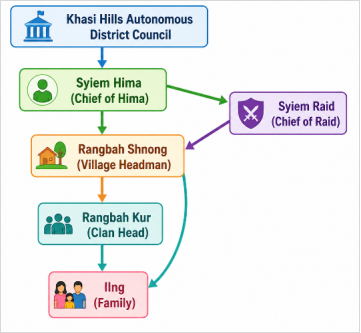
. Historically, the Khasi people have a four-tier governance system (Figure 1 below): the Hima (chiefdom) at the top, Raids (communes) in between, the Dorbar Shnong (village council), and the Kur (clan) at the base
[1]
Nongrum, Rubenker & Dash, Trilochan. Tribal’s perception on governance of Village Council (Dorbar) system: A case study of West Khasi Hills District of Meghalaya state. 2021, Vol. XIII, Issue-I, pp-34-68.
. Today, these traditional institutions re under the administration of the Autonomous District Council (ADC) provided under the Sixth Schedule of the Indian Constitution. The Village Dorbar (Dorbar Shnong) is the local council comprising all adult Khasi villagers
[3]
Government of Meghalaya (Khasi Hills Autonomous District Council). TheKhasiHillsAutonomousDistrict(VillageAdministration)Act,2014. 2014. Available from
, and it meets under customary law (often called Ka Dorbar Ble or “God’s council”) to deliberate on communal affairs
[1]
Nongrum, Rubenker & Dash, Trilochan. Tribal’s perception on governance of Village Council (Dorbar) system: A case study of West Khasi Hills District of Meghalaya state. 2021, Vol. XIII, Issue-I, pp-34-68.
. The Rangbah Shnong is the elected village headman who presides over this council and acts as both administrator and dispute-settler
[1]
Nongrum, Rubenker & Dash, Trilochan. Tribal’s perception on governance of Village Council (Dorbar) system: A case study of West Khasi Hills District of Meghalaya state. 2021, Vol. XIII, Issue-I, pp-34-68.
. These institutions are deeply rooted in Khasi tradition and have no formal written constitution, although they have received partial statutory recognition under Meghalaya’s autonomy laws
[2]
The Shillong Times. Governance of DorbarShnong and powers of RangbahShnong in the modern world. 2024, October 17.
Government of Meghalaya (Khasi Hills Autonomous District Council). TheKhasiHillsAutonomousDistrict(VillageAdministration)Act,2014. 2014. Available from
Baruah, A. K. (2004). EthnicConflictsandTraditionalSelf-governingInstitutions:AStudyofLaitumkhrahDorbar. Crisis States Programme, LSE (Working Paper No. 39). 2004. Available from
Figure 1. Typical hierarchy of traditional institutions in Khasi Hills, Meghalaya.
Kharmylliem and Kipgen (2026) emphasise that “the Khasi Hills … are governed by traditional institutions, popularly known as dorbar shnongs or village councils”
[4]
Kharmylliem, B., & Kipgen, N. Social capital and traditional institutions: Water governance in the East Khasi Hills, Meghalaya. SociologicalBulletin.2026,75(1), 141–156.
. Similarly, Baruah’s study of Laitumkhrah Dorbar (Shillong) found that these councils, though “controversial” in a modern context, remain influential and under pressure to accommodate constitutional norms
[5]
Baruah, A. K. (2004). EthnicConflictsandTraditionalSelf-governingInstitutions:AStudyofLaitumkhrahDorbar. Crisis States Programme, LSE (Working Paper No. 39). 2004. Available from
Gassah, L. S. Lyngdoh, RevisitingTraditionalInstitutionsintheKhasi-JaintiaHills:InterfaceofContinuityandChange.In Charles Reuben, ed. RevisitingTraditionalInstitutionsintheKhasi-JaintiaHills. Newcastle upon Tyne: Cambridge Scholars Publishing, 2016, pp. 1-6.
[5, 6]
. Local press and Non-Governmental Organization (NGO) reports confirm that Rangbah Shnongs and Dorbar councils are vital but often operate without formal government pay or resources
[2]
The Shillong Times. Governance of DorbarShnong and powers of RangbahShnong in the modern world. 2024, October 17.
Kharmylliem, B., & Kipgen, N. Social capital and traditional institutions: Water governance in the East Khasi Hills, Meghalaya. SociologicalBulletin.2026,75(1), 141–156.
Marngar, B., & Adhikary, A. The historical, political and socio-cultural factors influencing women’s political participation in village councils, Meghalaya. InternationalJournalforMultidisciplinaryResearch.2025, 7(6), 32–43.
. The problem addressed here is how the Dorbar Shnong and Rangbah Shnong of Umniuh Village function on the ground, and how they interact with state institutions. Studies have noted tensions: e.g. traditional male-dominated leadership coexists with modern demands for inclusion
[2]
The Shillong Times. Governance of DorbarShnong and powers of RangbahShnong in the modern world. 2024, October 17.
Marngar, B., & Adhikary, A. The historical, political and socio-cultural factors influencing women’s political participation in village councils, Meghalaya. InternationalJournalforMultidisciplinaryResearch.2025, 7(6), 32–43.
. There are gaps in understanding their day-to-day roles (development projects, dispute resolution, law and order), the composition of the council and its decision-making processes, and challenges such as women’s exclusion and legal accountability
[2]
The Shillong Times. Governance of DorbarShnong and powers of RangbahShnong in the modern world. 2024, October 17.
Marngar, B., & Adhikary, A. The historical, political and socio-cultural factors influencing women’s political participation in village councils, Meghalaya. InternationalJournalforMultidisciplinaryResearch.2025, 7(6), 32–43.
. In Umniuh specifically, comprehensive documentation was lacking. Therefore this research problem asks: How do Umniuh’s Dorbar Shnong and Rangbah Shnong actually operate, and what do the study reveal about their authority, functions, and challenges in the plural legal context of Meghalaya? Addressing this fills a gap in Khasi governance studies and informs policy on grassroots autonomy.
3. Objectives
This study aims to provide a detailed, comparative account of Umniuh’s customary institutions, guided by these objectives:
1) Describe the structure and functions of the Umniuh Village Dorbar (Dorbar Shnong) and its head (Rangbah Shnong) within local governance.
2) Explain the election/selection process and criteria for the Rangbah Shnong and council composition (e.g. Ka Teh Rangbah process).
3) Analyze the roles and responsibilities of these bodies in village administration, for example, law & order, land management, resource use, dispute settlement, issuance of certificates, and development projects.
4) Assess how these institutions interact with formal governance (District Council, state government) and customary chiefs, including legal sanction (e.g. sanad appointments).
5) Identify challenges and gaps, such as gender inclusion, resource constraints, or legal ambiguities, from the field evidence.
4. Research Methodology
Area of Study: Umniuh is a Khasi village in Ri-Bhoi District, Meghalaya, India (subdivision under Khasi Hills ADC). It lies near Umiam Lake and is governed by Khasi customary law. The site was chosen as a case exemplifying Khasi local governance. It is situated 17km away from sub-district headquarter Umsning (tehsildar office) and 37km away from district headquarter Nongpoh. According to Census 2011, the population of the Village stands at 455 with 220 male and 235 female. Umnuih village has 424 residents from the Scheduled Tribes (ST). The literacy rate of Umnuih village is about 63.30%, with male literacy at 60.00% and female literacy at 66.38%. The biggest numbers of the Umniuh population follows Christianity as their religion.
Sample: The study focus on village leadership. In particular, the Rangbah Shnong (village headman) was the primary informant in each report. Respondents also included other Dorbar Shnong executive members (secretary, treasurer and elders).
Data Collection Instruments: The researchers used a mix of qualitative methods. Common instruments were:
1) Semi-structured interviews with the Rangbah Shnong, Dorbar elders, and selected villagers. Questions focused on Dorbar functions, election process, and village issues.
2) Focus group discussions with community members to gather multiple perspectives.
3) Participant observation: researchers attended Dorbar Shnong meetings and village gatherings to observe decision-making and social dynamics.
4) Document review: examination of any available records (e.g. registers, meeting minutes, sanad certificates, district circulars) and relevant secondary sources (Village Administration Act, Khasi customary law texts).
Data Analysis: Data were analysed primarily by thematic coding. Interview transcripts and notes were coded for recurring themes (e.g. “election criteria,” “women’s role,” “development projects”). The study used qualitative (thematic) analysis to interpret findings. Simple descriptive statistics were also reported where relevant (e.g. population literacy rate 63.3%
[7]
Marngar, B., & Adhikary, A. The historical, political and socio-cultural factors influencing women’s political participation in village councils, Meghalaya. InternationalJournalforMultidisciplinaryResearch.2025, 7(6), 32–43.
, Dorbar gender composition). Cross-validation (triangulation) was used: for example, the study compared interviews with district-level documents to check accuracy
[7]
Marngar, B., & Adhikary, A. The historical, political and socio-cultural factors influencing women’s political participation in village councils, Meghalaya. InternationalJournalforMultidisciplinaryResearch.2025, 7(6), 32–43.
5. Conceptual Framework: Village Dorbar & RangbahShnong
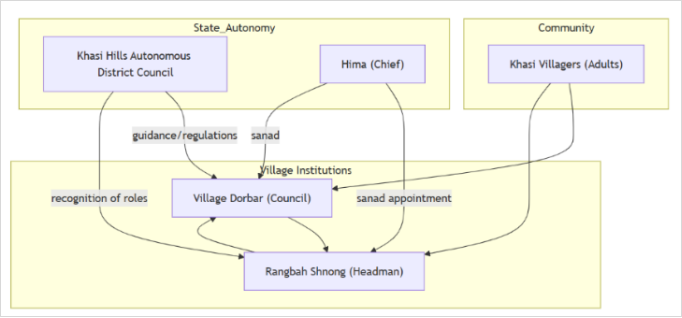
The following framework (Figure 2) illustrates how the Dorbar Shnong and Rangbah Shnong fit into Khasi governance. The Dorbar Shnong is conceptualised as an open council of all adult Khasi villagers (≥18 years)
[8]
Tiwari, B. K. StructureandFunctioningofTraditionalInstitutionsinMeghalaya,India. ResearchGate Preprint. 2019.
. In Umniuh it meets periodically to make decisions by consensus, guided by local customs. The Rangbah Shnong is the executive headman, elected by the male villagers
[1]
Nongrum, Rubenker & Dash, Trilochan. Tribal’s perception on governance of Village Council (Dorbar) system: A case study of West Khasi Hills District of Meghalaya state. 2021, Vol. XIII, Issue-I, pp-34-68.
. He chairs the Dorbar, enforces its rulings, and liaises upwards. Both institutions draw authority from customary tradition and collective legitimacy more than written law
[1]
Nongrum, Rubenker & Dash, Trilochan. Tribal’s perception on governance of Village Council (Dorbar) system: A case study of West Khasi Hills District of Meghalaya state. 2021, Vol. XIII, Issue-I, pp-34-68.
Government of Meghalaya (Khasi Hills Autonomous District Council). TheKhasiHillsAutonomousDistrict(VillageAdministration)Act,2014. 2014. Available from
, though they operate under the protective umbrella of Meghalaya’s Sixth Schedule and the Khasi Hills Autonomous District legislation
[3]
Government of Meghalaya (Khasi Hills Autonomous District Council). TheKhasiHillsAutonomousDistrict(VillageAdministration)Act,2014. 2014. Available from
Baruah, A. K. (2004). EthnicConflictsandTraditionalSelf-governingInstitutions:AStudyofLaitumkhrahDorbar. Crisis States Programme, LSE (Working Paper No. 39). 2004. Available from
. For example, the Village Administration Act (2014) codifies that each village must have a Dorbar Shnong composed of all Khasi residents over 18
[3]
Government of Meghalaya (Khasi Hills Autonomous District Council). TheKhasiHillsAutonomousDistrict(VillageAdministration)Act,2014. 2014. Available from
, and it defines the Rangbah Shnong as the village head elected by prevailing custom
[3]
Government of Meghalaya (Khasi Hills Autonomous District Council). TheKhasiHillsAutonomousDistrict(VillageAdministration)Act,2014. 2014. Available from
. In practice, however, the Dorbar and its Rangbah maintain roles through unwritten norms (sanads granted by the Hima chief)
[3]
Government of Meghalaya (Khasi Hills Autonomous District Council). TheKhasiHillsAutonomousDistrict(VillageAdministration)Act,2014. 2014. Available from
Baruah, A. K. (2004). EthnicConflictsandTraditionalSelf-governingInstitutions:AStudyofLaitumkhrahDorbar. Crisis States Programme, LSE (Working Paper No. 39). 2004. Available from
1) Composition: Village Dorbar = all adult Khasi villagers (members join via the annual Ka Teh Rangbah ceremony)
[3]
Government of Meghalaya (Khasi Hills Autonomous District Council). TheKhasiHillsAutonomousDistrict(VillageAdministration)Act,2014. 2014. Available from
. Rangbah Shnong = elected village headman (also called Sordar Shnong, elected from among adult men)
[1]
Nongrum, Rubenker & Dash, Trilochan. Tribal’s perception on governance of Village Council (Dorbar) system: A case study of West Khasi Hills District of Meghalaya state. 2021, Vol. XIII, Issue-I, pp-34-68.
Government of Meghalaya (Khasi Hills Autonomous District Council). TheKhasiHillsAutonomousDistrict(VillageAdministration)Act,2014. 2014. Available from
2) Governance Roles: Dorbar Shnong deliberates on village affairs (disputes, land matters, customs, development). Rangbah Shnong executes council decisions, maintains order (acting as de facto magistrate/police), and represents the village to external authorities
[1]
Nongrum, Rubenker & Dash, Trilochan. Tribal’s perception on governance of Village Council (Dorbar) system: A case study of West Khasi Hills District of Meghalaya state. 2021, Vol. XIII, Issue-I, pp-34-68.
Lyngdoh, Arthur. “Traditional Village Council (Durbar Shnong) in the Khasi Hills: Continuities and Change.” InternationalJournalofCreativeResearchThoughts 9. 2021, 4, 2453-2456. Available from
3) Customary vs. Formal Authority: Decisions in the Dorbar rely on consensus and customary law (e.g. clan norms)
[1]
Nongrum, Rubenker & Dash, Trilochan. Tribal’s perception on governance of Village Council (Dorbar) system: A case study of West Khasi Hills District of Meghalaya state. 2021, Vol. XIII, Issue-I, pp-34-68.
. Formally, their powers are acknowledged by District Council regulations (e.g. sanctioning a Village Development Council)
[3]
Government of Meghalaya (Khasi Hills Autonomous District Council). TheKhasiHillsAutonomousDistrict(VillageAdministration)Act,2014. 2014. Available from
Marngar, B., & Adhikary, A. The historical, political and socio-cultural factors influencing women’s political participation in village councils, Meghalaya. InternationalJournalforMultidisciplinaryResearch.2025, 7(6), 32–43.
4) Gender and Society: The Khasi matrilineal system theoretically disperses power, yet village governance remains male-led by tradition
[7]
Marngar, B., & Adhikary, A. The historical, political and socio-cultural factors influencing women’s political participation in village councils, Meghalaya. InternationalJournalforMultidisciplinaryResearch.2025, 7(6), 32–43.
Figure 2. Conceptual framework of governance: the Umniuh Village Dorbar Shnong (council) and Rangbah Shnong (headman) operate through customary norms and consensus but within the broader Khasi Hills autonomy system. Villagers participate in both institutions; the Hima (traditional state) and the District Council provide formal sanction.
6. Field Work and Data Analysis
Each research team conducted on-site visits, often beginning with an introductory meeting with the Rangbah Shnong and Khasi elders. Researchers observed Dorbar Shnong gatherings (usually open meetings in a community space) and village events, taking detailed notes of proceedings and interactions. For example, one team noted how adults file into the Dorbar meeting and address the council by respectful titles, while the Rangbah calls for consensus on issues. Interviews with the Rangbah Shnong and council members (often held at the headman’s compound) were recorded in notes, focusing on election processes, duties, and recent decisions. A few village-level questionnaires (e.g. on infrastructure or demographics) were also administered.
Data analysis involved thematic coding: interview transcripts were coded for concepts like “electoral criteria”, “customary laws”, “development projects”, and “social cohesion. For instance, the study noted unanimous or majority male voting in selecting the Rangbah Shnong
[1]
Nongrum, Rubenker & Dash, Trilochan. Tribal’s perception on governance of Village Council (Dorbar) system: A case study of West Khasi Hills District of Meghalaya state. 2021, Vol. XIII, Issue-I, pp-34-68.
, confirming consistency. The analysis also triangulated interview data with legal texts: for example, when a respondent described issuing residential certificates, we checked the 2014 Act, which empowers Dorbars to maintain registers of villagers
[3]
Government of Meghalaya (Khasi Hills Autonomous District Council). TheKhasiHillsAutonomousDistrict(VillageAdministration)Act,2014. 2014. Available from
. No advanced statistics were needed, but simple counts (e.g. Dorbar member numbers, age of headman) helped describe the setting. Critical reflection by the researchers ensured findings matched observed reality (e.g. if a council meeting seemed unanimous, the recorder cross-checked by asking multiple members later). Overall, the study reveal how Umniuh’s Dorbar Shnongfunctions as a participatory council, and how the Rangbah Shnongoperates as community leader.
7. Major Findings
The following major findings emerged about Umniuh’s Dorbar Shnong and Rangbah Shnong:
1) Participatory Selection of Rangbah Shnong: The study found that the Rangbah Shnong is elected by the adult Khasi men of the village, often requiring a consensus or a majority vote in the Dorbar Shnong meeting. Candidates are assessed on personal qualities and community reputation rather than formal education. The study noted that “personal character” is more important than qualifications in choosing the headman. Once elected, the headman is expected to serve unpaid and for a customary term; the village met with state officials who were “surprised” that leaders work without remuneration.
2) Functions of the Dorbar Shnong: The council meeting itself deals with all village issues. It maintains a population register of villagers (necessary for issuing certificates under customary law). It adjudicates land and family disputes, often preferring mediation under tradition. Members reported that the Dorbar imposes fines or sanctions for infractions (e.g. breaking local rules). The Dorbar also takes care of communal projects: in Umniuh this included supervising road maintenance, water supply, and sanitation facilities. Reports confirm that the Rangbah and council “looked after the welfare of the village such as water supply, health, roads, education”. In short, the Dorbar Shnong acts as a sacred council safeguarding customs and organizing development, consistent with Khasi tradition.
3) Role of the Rangbah Shnong: As headman, the Rangbah Shnong presides over Dorbar meetings and implements council resolutions. He is described as the executive leader and main mediator. For example, one report observes: “Acts as the chief executive and leader of the village, implementing Dorbar Shnong decisions. Plays a key role in maintaining peace, resolving disputes, and managing village resources.” This aligns with formal descriptions that the village headman performs the dual role of magistrate and police officer. The Rangbah Shnong also represents Umniuh to the District Council and higher chiefs, conveying villagers’ requests (e.g. for development funds). Community members said the Rangbah has a strong connection with residents and “goes hand in hand with the people,” illustrating his legitimacy. All agreed the office is held in trust – “the power of Rangbah Shnong comes from the people” – rather than derived from state salary or order.
4) Gender and Participation: A common finding was that formal Dorbar meetings include only men; women do not sit in council meetings nor vote on the Rangbah’s election. This exclusion stems from longstanding norms, as noted in the literature. All reports noted the absence of women in the Dorbar Shnong (only male members were listed). One report explicitly stated “The participation of women in the Dorbar Council is prohibited.” This reflects Meghalaya’s Sixth Schedule framework, which preserves male-based leadership unless district rules intervene
[7]
Marngar, B., & Adhikary, A. The historical, political and socio-cultural factors influencing women’s political participation in village councils, Meghalaya. InternationalJournalforMultidisciplinaryResearch.2025, 7(6), 32–43.
. (However, all teams noted that women participate informally in community discussions outside the council room).
5) Relation with Formal Institutions: The Rangbah Shnong is recognized via a sanad from the Syiem (chief) or District Council, but this legal appointment is more a formality
[11]
Laloo, M. N. Political Structure of the Khasis: With special reference to the Nongthymmai Dorbar Pyllun. IOSRJournalofHumanitiesandSocialScience. 2014, 19(4), 45-53. 10.9790/0837-19474553.
. In practice, villagers and even the media described village leadership as grounded in tradition. For instance, the study emphasizes that these “village leaders work voluntarily without remuneration” and derive authority from customary trust. During crises (e.g. the COVID pandemic or local conflicts), state officials have often turned to the Dorbar and Rangbah for action, suggesting these bodies function as de facto local government
[12]
Kakati, Bhaskar Kumar. “Role of Traditional Institutions in Covid-19 Management: A Case Study of DorbarShnong in Meghalaya, India.” LocalDevelopment&Society. 2025, 6(3), 486-498.
. Nonetheless, the reports point out legal ambiguities: modern laws like the Khasi Hills District Act outline Dorbar duties
[3]
Government of Meghalaya (Khasi Hills Autonomous District Council). TheKhasiHillsAutonomousDistrict(VillageAdministration)Act,2014. 2014. Available from
, but in Umniuh (as elsewhere) the actual power remains in customary practice rather than statutory enforcement.
6) Traditional Authority and Social Cohesion: The study highlights that Dorbar and Rangbah institutions foster a strong sense of community identity and cooperation. Villagers expressed pride in their self-governance: one team found that decisions in the Dorbar are taken “solely by the people’s consensus,” illustrating grassroots democracy. The Rangbah Shnong was often described as embodying village values. For example, one report notes the Rangbah “fosters a strong sense of belonging and mutual cooperation” among residents. Traditional ceremonies (like “Ka Teh Rangbah”) reinforce this cohesion, as new adults are formally introduced to the Dorbar.
These findings are consistent with literatures on the field: Baruah (2004) similarly observed that Khasi Dorbar councils manage local affairs with consensus, and that tradition adapts to modern challenges
[5]
Baruah, A. K. (2004). EthnicConflictsandTraditionalSelf-governingInstitutions:AStudyofLaitumkhrahDorbar. Crisis States Programme, LSE (Working Paper No. 39). 2004. Available from
. The highlandpost study notes the autonomy of the Dorbar Shnong and its power to resist external interference
[14]
Warjri, R. Khasifolkdemocracy:Customarygovernance,autonomy,andrepresentation Khasi Folk Democracy: Customary Governance, Autonomy, and Representation. Highland Post. (2025, October 20). Available from
, matching Umniuh’s experience of strong local control. Overall, the major finding is that Umniuh’s Dorbar Shnong and Rangbah Shnong operate as a customary governance system that is participatory (for men), self-sustaining (volunteer-based), and pivotal for village welfare, yet remains largely outside formal state power structures
[1]
Nongrum, Rubenker & Dash, Trilochan. Tribal’s perception on governance of Village Council (Dorbar) system: A case study of West Khasi Hills District of Meghalaya state. 2021, Vol. XIII, Issue-I, pp-34-68.
The synthesis of the study confirms that Khasi grassroots institutions continue to play central roles in local governance. In Umniuh, as in other Khasi villages, the Dorbar Shnong and Rangbah Shnong exemplify a living “folk democracy”
[2]
The Shillong Times. Governance of DorbarShnong and powers of RangbahShnong in the modern world. 2024, October 17.
Kharmylliem, B., & Kipgen, N. Social capital and traditional institutions: Water governance in the East Khasi Hills, Meghalaya. SociologicalBulletin.2026,75(1), 141–156.
. The model has strengths: it mobilises social capital for water and land management
[4]
Kharmylliem, B., & Kipgen, N. Social capital and traditional institutions: Water governance in the East Khasi Hills, Meghalaya. SociologicalBulletin.2026,75(1), 141–156.
, and it adapts to change (for example, creating committees for disputes as per modern needs
[3]
Government of Meghalaya (Khasi Hills Autonomous District Council). TheKhasiHillsAutonomousDistrict(VillageAdministration)Act,2014. 2014. Available from
). However, challenges arise at the intersection of tradition and law. The Sixth Schedule protects these bodies, but also insulates them from state gender reforms
[7]
Marngar, B., & Adhikary, A. The historical, political and socio-cultural factors influencing women’s political participation in village councils, Meghalaya. InternationalJournalforMultidisciplinaryResearch.2025, 7(6), 32–43.
. The study highlighted that unless district authorities mandate change, practices like male-only councils persist, limiting women’s political voice.
The role of the Rangbah Shnong as community liaison is noteworthy: he channels government schemes (e.g. road and development funds) but with no formal budget or staff. This creates a hybrid governance situation, where customary norms and formal duties overlap
[2]
The Shillong Times. Governance of DorbarShnong and powers of RangbahShnong in the modern world. 2024, October 17.
Marngar, B., & Adhikary, A. The historical, political and socio-cultural factors influencing women’s political participation in village councils, Meghalaya. InternationalJournalforMultidisciplinaryResearch.2025, 7(6), 32–43.
, essentially filling a local leadership void. The finding that Rangbahs are unpaid volunteers was echoed by the Indian Home Minister’s surprise when briefed by Khasi leaders
[2]
The Shillong Times. Governance of DorbarShnong and powers of RangbahShnong in the modern world. 2024, October 17.
Comparing Umniuh to other cases (e.g. Baruah’s Shillong Dorbar or Kharmylliem’s water governance villages), Umniuh is typical: strong consensus councils, male leadership, and self-reliance. Notably, the study (and the literature) find that traditional power derives from social legitimacy. For example, Baruah notes that “tradition is under pressure to accommodate constitutional norms”
[5]
Baruah, A. K. (2004). EthnicConflictsandTraditionalSelf-governingInstitutions:AStudyofLaitumkhrahDorbar. Crisis States Programme, LSE (Working Paper No. 39). 2004. Available from
, and our data show this tension: villagers uphold customary law even as they interact with modern state institutions.
Conclusion: Umniuh’s Village Dorbar and Rangbah Shnong remain vital to everyday governance. They address basic community needs and preserve cultural identity, even without formal state support or explicit legal mandates. This suggests that policymakers should not undermine these institutions; rather, supporting them (for instance, by providing training, clarifying legal roles, or encouraging inclusivity) could strengthen local governance. In the plural system of Meghalaya, where formal and customary institutions coexist
[2]
The Shillong Times. Governance of DorbarShnong and powers of RangbahShnong in the modern world. 2024, October 17.
Gassah, L. S. Lyngdoh, RevisitingTraditionalInstitutionsintheKhasi-JaintiaHills:InterfaceofContinuityandChange.In Charles Reuben, ed. RevisitingTraditionalInstitutionsintheKhasi-JaintiaHills. Newcastle upon Tyne: Cambridge Scholars Publishing, 2016, pp. 1-6.
[2, 6]
, enhancing coordination is key. Ultimately, the case of Umniuh illustrates that durable governance at the grassroots rests on tradition-backed institutions that command community trust and participation.
Thingbaijam Alice: Data curation, Investigation, Writing – original draft
Thangminlun Haokip: Data curation, Investigation, Writing – original draft
Teli Pompi: Data curation, Investigation, Writing – original draft
Thompson V Beiraduasa: Data curation, Investigation, Writing – original draft
Kyntibajanai Mawlong: Data curation, Investigation, Writing – original draft
Zomuanpuia: Data curation, Investigation, Writing – original draft
Willsium Reang: Data curation, Investigation, Writing – original draft
Conflicts of Interest
The authors declare no conflicts of interest.
References
[1]
Nongrum, Rubenker & Dash, Trilochan. Tribal’s perception on governance of Village Council (Dorbar) system: A case study of West Khasi Hills District of Meghalaya state. 2021, Vol. XIII, Issue-I, pp-34-68.
Government of Meghalaya (Khasi Hills Autonomous District Council). TheKhasiHillsAutonomousDistrict(VillageAdministration)Act,2014. 2014. Available from
Kharmylliem, B., & Kipgen, N. Social capital and traditional institutions: Water governance in the East Khasi Hills, Meghalaya. SociologicalBulletin.2026,75(1), 141–156.
Baruah, A. K. (2004). EthnicConflictsandTraditionalSelf-governingInstitutions:AStudyofLaitumkhrahDorbar. Crisis States Programme, LSE (Working Paper No. 39). 2004. Available from
Gassah, L. S. Lyngdoh, RevisitingTraditionalInstitutionsintheKhasi-JaintiaHills:InterfaceofContinuityandChange.In Charles Reuben, ed. RevisitingTraditionalInstitutionsintheKhasi-JaintiaHills. Newcastle upon Tyne: Cambridge Scholars Publishing, 2016, pp. 1-6.
[7]
Marngar, B., & Adhikary, A. The historical, political and socio-cultural factors influencing women’s political participation in village councils, Meghalaya. InternationalJournalforMultidisciplinaryResearch.2025, 7(6), 32–43.
Lyngdoh, Arthur. “Traditional Village Council (Durbar Shnong) in the Khasi Hills: Continuities and Change.” InternationalJournalofCreativeResearchThoughts 9. 2021, 4, 2453-2456. Available from
Laloo, M. N. Political Structure of the Khasis: With special reference to the Nongthymmai Dorbar Pyllun. IOSRJournalofHumanitiesandSocialScience. 2014, 19(4), 45-53. 10.9790/0837-19474553.
Kakati, Bhaskar Kumar. “Role of Traditional Institutions in Covid-19 Management: A Case Study of DorbarShnong in Meghalaya, India.” LocalDevelopment&Society. 2025, 6(3), 486-498.
Warjri, R. Khasifolkdemocracy:Customarygovernance,autonomy,andrepresentation Khasi Folk Democracy: Customary Governance, Autonomy, and Representation. Highland Post. (2025, October 20). Available from
Mawlong, B. L., Alice, T., Haokip, T., Pompi, T., Beiraduasa, T. V., et al. (2026). Custom, Consensus, and Authority: Khasi Traditional Institutions and Local Governance in Umniuh Village, Meghalaya. Social Sciences, 15(3), 118-123. https://doi.org/10.11648/j.ss.20261503.12
Mawlong, B. L.; Alice, T.; Haokip, T.; Pompi, T.; Beiraduasa, T. V., et al. Custom, Consensus, and Authority: Khasi Traditional Institutions and Local Governance in Umniuh Village, Meghalaya. Soc. Sci.2026, 15(3), 118-123. doi: 10.11648/j.ss.20261503.12
Mawlong BL, Alice T, Haokip T, Pompi T, Beiraduasa TV, et al. Custom, Consensus, and Authority: Khasi Traditional Institutions and Local Governance in Umniuh Village, Meghalaya. Soc Sci. 2026;15(3):118-123. doi: 10.11648/j.ss.20261503.12
@article{10.11648/j.ss.20261503.12,
  author = {Banshaikupar Lyngdoh Mawlong and Thingbaijam Alice and Thangminlun Haokip and Teli Pompi and Thompson V Beiraduasa and Kyntibajanai Mawlong and Zomuanpuia and Willsium Reang},
  title = {Custom, Consensus, and Authority: Khasi Traditional Institutions and Local Governance in Umniuh Village, Meghalaya},
  journal = {Social Sciences},
  volume = {15},
  number = {3},
  pages = {118-123},
  doi = {10.11648/j.ss.20261503.12},
  url = {https://doi.org/10.11648/j.ss.20261503.12},
  eprint = {https://article.sciencepublishinggroup.com/pdf/10.11648.j.ss.20261503.12},
  abstract = {This paper seek to analyse the Khasi traditional institutions of local governance: the Dorbar Shnong (village council) and the Rangbah Shnong (village headman). Drawing on field study report, official legislation, and academic studies, we examine how these bodies function in practice, their legal context, and their roles in modern governance. In Umniuh, the Dorbar Shnong is an all-adult council that meets to make consensus decisions on local matters, while the Rangbah Shnong is the elected leader who implements council resolutions. The study found that villagers (adult men) actively participate in Dorbar meetings and respect these customs for law, land, and development decisions. The interplay between customary practice and statutory law emerges as a theme: for example, the Khasi Hills Autonomous District Act (2014) recognizes Dorbar Shnongs and defines their functions, yet in practice their authority comes from local norms (the “sanad” of traditional rulers) more than modern law. Methodologically, data were gathered through interviews with the Rangbah Shnong and Dorbar members, observation of Dorbar meetings, focus groups, and document review, and analysed by thematic coding and simple descriptive statistics. In conclusion, we discuss how Umniuh’s Dorbar Shnong and Rangbah Shnong exemplify Khasi “folk democracy”, highlighting both the strengths of participatory customary governance and its challenges.},
 year = {2026}
}
TY  - JOUR
T1  - Custom, Consensus, and Authority: Khasi Traditional Institutions and Local Governance in Umniuh Village, Meghalaya
AU  - Banshaikupar Lyngdoh Mawlong
AU  - Thingbaijam Alice
AU  - Thangminlun Haokip
AU  - Teli Pompi
AU  - Thompson V Beiraduasa
AU  - Kyntibajanai Mawlong
AU  - Zomuanpuia
AU  - Willsium Reang
Y1  - 2026/05/19
PY  - 2026
N1  - https://doi.org/10.11648/j.ss.20261503.12
DO  - 10.11648/j.ss.20261503.12
T2  - Social Sciences
JF  - Social Sciences
JO  - Social Sciences
SP  - 118
EP  - 123
PB  - Science Publishing Group
SN  - 2326-988X
UR  - https://doi.org/10.11648/j.ss.20261503.12
AB  - This paper seek to analyse the Khasi traditional institutions of local governance: the Dorbar Shnong (village council) and the Rangbah Shnong (village headman). Drawing on field study report, official legislation, and academic studies, we examine how these bodies function in practice, their legal context, and their roles in modern governance. In Umniuh, the Dorbar Shnong is an all-adult council that meets to make consensus decisions on local matters, while the Rangbah Shnong is the elected leader who implements council resolutions. The study found that villagers (adult men) actively participate in Dorbar meetings and respect these customs for law, land, and development decisions. The interplay between customary practice and statutory law emerges as a theme: for example, the Khasi Hills Autonomous District Act (2014) recognizes Dorbar Shnongs and defines their functions, yet in practice their authority comes from local norms (the “sanad” of traditional rulers) more than modern law. Methodologically, data were gathered through interviews with the Rangbah Shnong and Dorbar members, observation of Dorbar meetings, focus groups, and document review, and analysed by thematic coding and simple descriptive statistics. In conclusion, we discuss how Umniuh’s Dorbar Shnong and Rangbah Shnong exemplify Khasi “folk democracy”, highlighting both the strengths of participatory customary governance and its challenges.
VL  - 15
IS  - 3
ER  -
Mawlong, B. L., Alice, T., Haokip, T., Pompi, T., Beiraduasa, T. V., et al. (2026). Custom, Consensus, and Authority: Khasi Traditional Institutions and Local Governance in Umniuh Village, Meghalaya. Social Sciences, 15(3), 118-123. https://doi.org/10.11648/j.ss.20261503.12
Mawlong, B. L.; Alice, T.; Haokip, T.; Pompi, T.; Beiraduasa, T. V., et al. Custom, Consensus, and Authority: Khasi Traditional Institutions and Local Governance in Umniuh Village, Meghalaya. Soc. Sci.2026, 15(3), 118-123. doi: 10.11648/j.ss.20261503.12
Mawlong BL, Alice T, Haokip T, Pompi T, Beiraduasa TV, et al. Custom, Consensus, and Authority: Khasi Traditional Institutions and Local Governance in Umniuh Village, Meghalaya. Soc Sci. 2026;15(3):118-123. doi: 10.11648/j.ss.20261503.12
@article{10.11648/j.ss.20261503.12,
  author = {Banshaikupar Lyngdoh Mawlong and Thingbaijam Alice and Thangminlun Haokip and Teli Pompi and Thompson V Beiraduasa and Kyntibajanai Mawlong and Zomuanpuia and Willsium Reang},
  title = {Custom, Consensus, and Authority: Khasi Traditional Institutions and Local Governance in Umniuh Village, Meghalaya},
  journal = {Social Sciences},
  volume = {15},
  number = {3},
  pages = {118-123},
  doi = {10.11648/j.ss.20261503.12},
  url = {https://doi.org/10.11648/j.ss.20261503.12},
  eprint = {https://article.sciencepublishinggroup.com/pdf/10.11648.j.ss.20261503.12},
  abstract = {This paper seek to analyse the Khasi traditional institutions of local governance: the Dorbar Shnong (village council) and the Rangbah Shnong (village headman). Drawing on field study report, official legislation, and academic studies, we examine how these bodies function in practice, their legal context, and their roles in modern governance. In Umniuh, the Dorbar Shnong is an all-adult council that meets to make consensus decisions on local matters, while the Rangbah Shnong is the elected leader who implements council resolutions. The study found that villagers (adult men) actively participate in Dorbar meetings and respect these customs for law, land, and development decisions. The interplay between customary practice and statutory law emerges as a theme: for example, the Khasi Hills Autonomous District Act (2014) recognizes Dorbar Shnongs and defines their functions, yet in practice their authority comes from local norms (the “sanad” of traditional rulers) more than modern law. Methodologically, data were gathered through interviews with the Rangbah Shnong and Dorbar members, observation of Dorbar meetings, focus groups, and document review, and analysed by thematic coding and simple descriptive statistics. In conclusion, we discuss how Umniuh’s Dorbar Shnong and Rangbah Shnong exemplify Khasi “folk democracy”, highlighting both the strengths of participatory customary governance and its challenges.},
 year = {2026}
}
TY  - JOUR
T1  - Custom, Consensus, and Authority: Khasi Traditional Institutions and Local Governance in Umniuh Village, Meghalaya
AU  - Banshaikupar Lyngdoh Mawlong
AU  - Thingbaijam Alice
AU  - Thangminlun Haokip
AU  - Teli Pompi
AU  - Thompson V Beiraduasa
AU  - Kyntibajanai Mawlong
AU  - Zomuanpuia
AU  - Willsium Reang
Y1  - 2026/05/19
PY  - 2026
N1  - https://doi.org/10.11648/j.ss.20261503.12
DO  - 10.11648/j.ss.20261503.12
T2  - Social Sciences
JF  - Social Sciences
JO  - Social Sciences
SP  - 118
EP  - 123
PB  - Science Publishing Group
SN  - 2326-988X
UR  - https://doi.org/10.11648/j.ss.20261503.12
AB  - This paper seek to analyse the Khasi traditional institutions of local governance: the Dorbar Shnong (village council) and the Rangbah Shnong (village headman). Drawing on field study report, official legislation, and academic studies, we examine how these bodies function in practice, their legal context, and their roles in modern governance. In Umniuh, the Dorbar Shnong is an all-adult council that meets to make consensus decisions on local matters, while the Rangbah Shnong is the elected leader who implements council resolutions. The study found that villagers (adult men) actively participate in Dorbar meetings and respect these customs for law, land, and development decisions. The interplay between customary practice and statutory law emerges as a theme: for example, the Khasi Hills Autonomous District Act (2014) recognizes Dorbar Shnongs and defines their functions, yet in practice their authority comes from local norms (the “sanad” of traditional rulers) more than modern law. Methodologically, data were gathered through interviews with the Rangbah Shnong and Dorbar members, observation of Dorbar meetings, focus groups, and document review, and analysed by thematic coding and simple descriptive statistics. In conclusion, we discuss how Umniuh’s Dorbar Shnong and Rangbah Shnong exemplify Khasi “folk democracy”, highlighting both the strengths of participatory customary governance and its challenges.
VL  - 15
IS  - 3
ER  -





 Share This Article
 Twitter
 Linked In
 Facebook
 Copy
Copy Download